
Design solutions that pursue the sound quality and experience you need
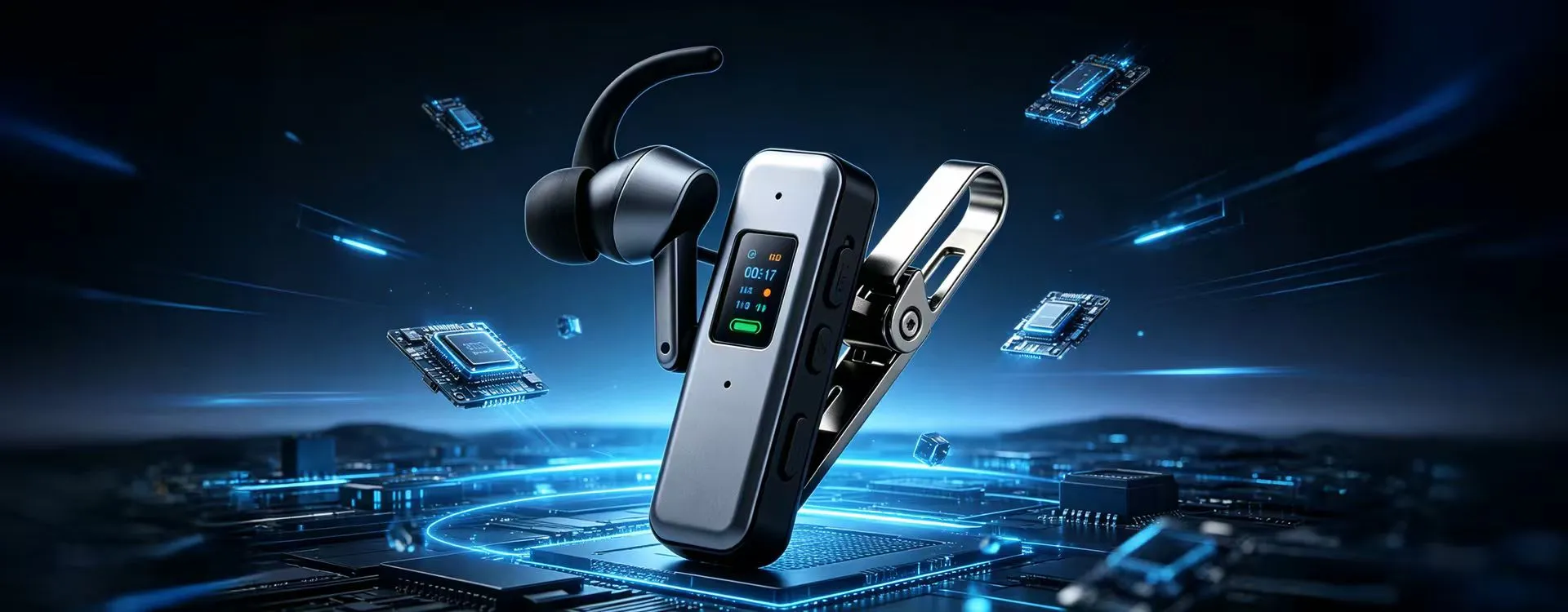
Sound travels through air as a longitudinal pressure wave. When two waves meet at the same point, their pressures add as vectors: waves in phase reinforce each other, while waves 180 degrees out of phase cancel each other. Active noise cancellation (ANC) exploits the latter effect: the headphone speaker generates a sound wave that is opposite in phase to the ambient noise and similar in amplitude, so the two waves superimpose near the ear canal and their combined pressure approaches zero. The listener does not hear noise that has been physically blocked, but noise that has been actively neutralized by an anti-phase wave.
An ANC headphone works as a continuous closed loop. First, a reference microphone picks up the ambient noise. Second, the audio DSP converts the analog signal to digital, runs adaptive filtering and phase inversion, and computes the anti-phase output. Third, the driver converts the processed signal back into sound that reaches the ear canal at the same time as the unwanted noise. The loop repeats in milliseconds. The adaptive filter at the processing stage is the heart of the system: it continuously updates its coefficients based on the noise spectrum, which explains why ANC performance varies across different products and acoustic environments.
Effective cancellation depends on precise phase alignment between the anti-phase wave and the original noise at the ear-drum position. Sound propagation takes time, and every stage in the chain—microphone capture, ADC, DSP processing, DAC, and speaker response—adds latency. Higher-frequency noise has shorter wavelengths and is therefore more sensitive to phase error. For example, a 1 kHz tone has a wavelength of about 34 cm; a one-quarter-wavelength phase error turns cancellation into reinforcement. That is why mainstream ANC platforms target loop latency in the sub-millisecond range and carefully tune feedforward filter phase response. Phase alignment accuracy directly defines both the depth and the usable bandwidth of active cancellation.
ANC is not equally effective across the entire spectrum. Low-to-mid frequencies, roughly 50 Hz to 1 kHz, have long wavelengths and forgiving phase tolerances, so they typically achieve 20 dB to 35 dB of active attenuation. High frequencies have short wavelengths and are hard to cancel actively, so they rely mainly on passive isolation from ear cushions and the acoustic enclosure. Strong cancellation can also create a pressure-like sensation for some users during long listening sessions. A mature design therefore balances attenuation, sound quality, latency, and wearing comfort by adjusting filter order, gain margin, and leakage compensation. Liwei Electronics offers complete ANC headphone PCBA solutions covering chip selection, acoustic design, and mass-production calibration.
Q: Why does ANC work better at low frequencies than high frequencies?
A: Low-frequency sound has long wavelengths, so a small phase error still allows the anti-phase wave to cancel the noise effectively. High-frequency sound has short wavelengths, so even tiny delays shift the phase enough to stop cancellation; high frequencies are therefore mainly blocked by passive ear-cup isolation.
Q: What is the difference between feedforward and feedback ANC?
A: Feedforward ANC uses an outer microphone to sample ambient noise before it reaches the ear, giving fast response but limited correction for leakage. Feedback ANC uses an inner microphone to measure residual noise and corrects the output in a closed loop, providing better low-frequency control but higher risk of instability at high gain. Premium products combine both architectures.
Q: Is a slight pressure sensation normal when ANC is turned on?
A: Yes. The pressure sensation is a perceptual effect caused by the sudden reduction of ambient sound pressure, not a real air-pressure change in the ear canal. Most users adapt within minutes. Designers can reduce it by lowering low-frequency gain, adding an ambient or transparency mode, or improving ear-pad venting.
Shenzhen Liwei Electronic Technology Co., Ltd has 12 years of experience in audio headset electronic solution design. We provide complete ANC active noise cancellation headphone PCBA solutions, from chip selection and acoustic design to mass-production calibration, serving 15+ well-known brands and 300+ customers. Request a Quote for a custom ANC headphone solution.
Keywords: ANC active noise cancellation, anti-phase wave, ANC headset design, active noise cancelling principle