
Design solutions that pursue the sound quality and experience you need
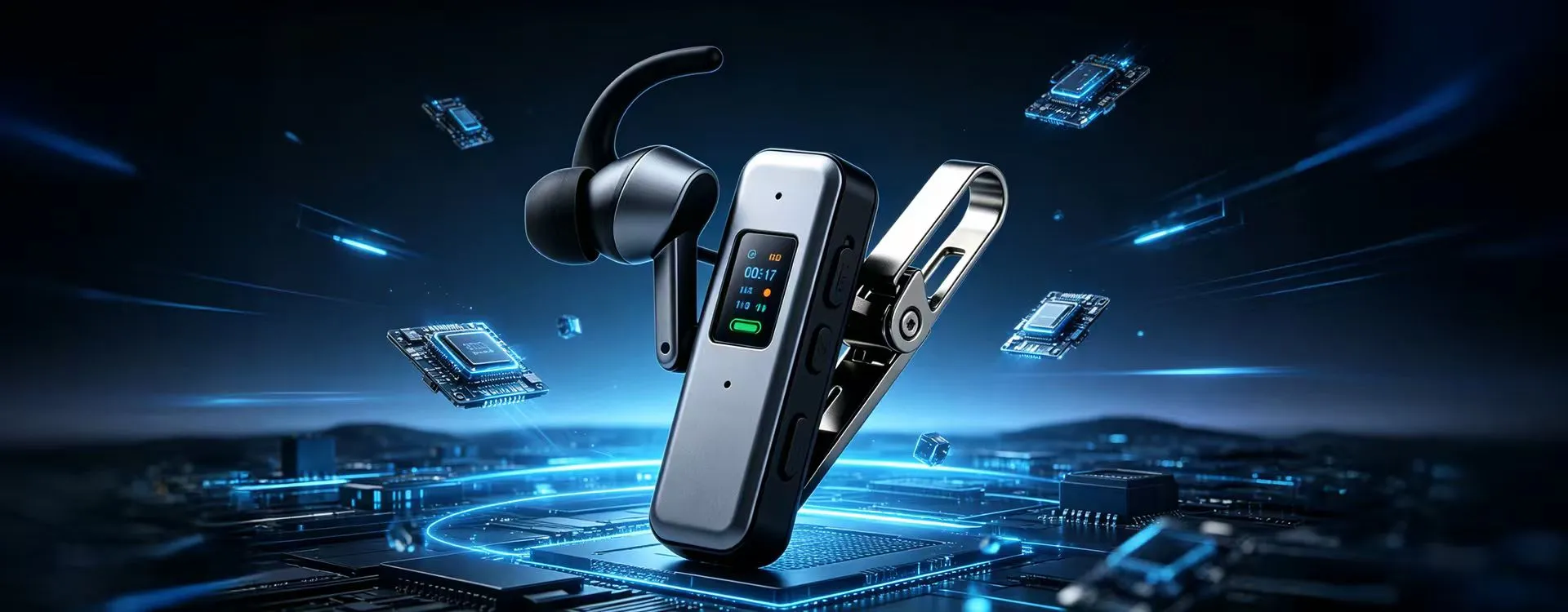
Active noise cancellation targets external noise reaching the listener's ear. ENC — call/environmental noise reduction — solves a different problem: separating the speaker's own voice from background noise before it is transmitted to the far end. The difficulty is that noise and speech overlap on the same microphone signal at the same moment, and their spectra largely overlap too, so filtering alone cannot pull them apart. The standard approach is beamforming: using the spatial positions of multiple microphones to distinguish "voice from the mouth" from "noise from all directions" at the physical level, then running noise-reduction algorithms to suppress the residue.
Dual-mic is the mainstream entry configuration: a primary mic near the mouth captures speech, a reference mic higher up or further back samples the ambient field, and the two signals go through differential processing that exploits the time-of-arrival difference to enhance voice and suppress environmental sound. Triple-mic adds another reference, typically forming feedforward and side noise paths that estimate the noise field more accurately — cleaner separation for wind noise and multi-talker scenes. Each added mic raises cost and mechanical complexity, so dual-mic plus strong algorithm optimization remains the best value for consumer products; triple-mic is common only in premium call headsets.
Three hardware factors set the ceiling on beamforming quality. Spacing: mic distance determines the separable frequency range and directional accuracy — too close and low-frequency separation fails; too far and voice phase-difference estimates grow error-prone, so the distance must fit the mechanical structure. Directivity: the primary mic should work with a tuned sound-inlet structure to form directional pickup that favors the voice from the front. Consistency: sensitivity mismatch between the two mics directly destroys differential cancellation, so mass production requires sensitivity calibration and pairing — the single biggest differentiator between good and mediocre ENC products.
Once the array hardware is in place, the real gap lies in algorithm tuning. A good ENC chain typically includes wind-noise detection, adaptive beamforming, residual noise suppression, and echo cancellation, switching parameters by scenario: subway noise calls for steady-state suppression, while windy conditions should trigger wind-noise handling before "whooshing" overloads the path. Tuning must also protect double-talk, so the far-end speaker's voice is not mistakenly clipped. Liwei Electronics provides full support for call headsets — from mic-array structure advice and chip selection to DSP parameter tuning — helping move ENC from "usable for calls" to "clearly audible."
Q: How big is the difference between dual-mic ENC and single-mic noise reduction?
A: Significant. A single mic can only estimate noise algorithmically with limited separation; dual-mic differential processing uses spatial position to distinguish voice from noise direction, giving clearly higher intelligibility with the same algorithm — and far more effective wind-noise suppression.
Q: Is triple-mic always better than dual-mic?
A: Not necessarily. Triple-mic separates complex noise fields and multi-talker scenes more accurately, but costs more, complicates the structure, and demands harder tuning. For ordinary calls and office meetings, dual-mic plus mature algorithms usually offers better value.
Q: Why do different products with the same chip sound very different in calls?
A: The difference is mic selection and matching, inlet/structural acoustic design, and DSP tuning. The same chip does not mean the same result — mic sensitivity pairing and scenario-specific parameter tuning are what decide mass-production call quality.
Shenzhen Liwei Electronics specializes in audio headphone electronic design, delivering complete chip and PCBA solutions with 12 years of experience, 15+ well-known brands, and 300+ customers. We provide ENC call-noise-reduction headset solutions with mic-array structure and DSP tuning support. Contact us to request a quote for your custom design.
Shenzhen Liwei Electronics specializes in audio headphone electronic design, delivering complete chip and PCBA solutions with 12 years of experience, 15+ well-known brands, and 300+ customers. We provide ENC call-noise-reduction headset solutions with mic-array structure and DSP tuning support. Contact us to request a quote for your custom design.
Keywords: ENC call noise reduction, dual-mic beamforming, triple-mic noise reduction, call headset solution