
Design solutions that pursue the sound quality and experience you need
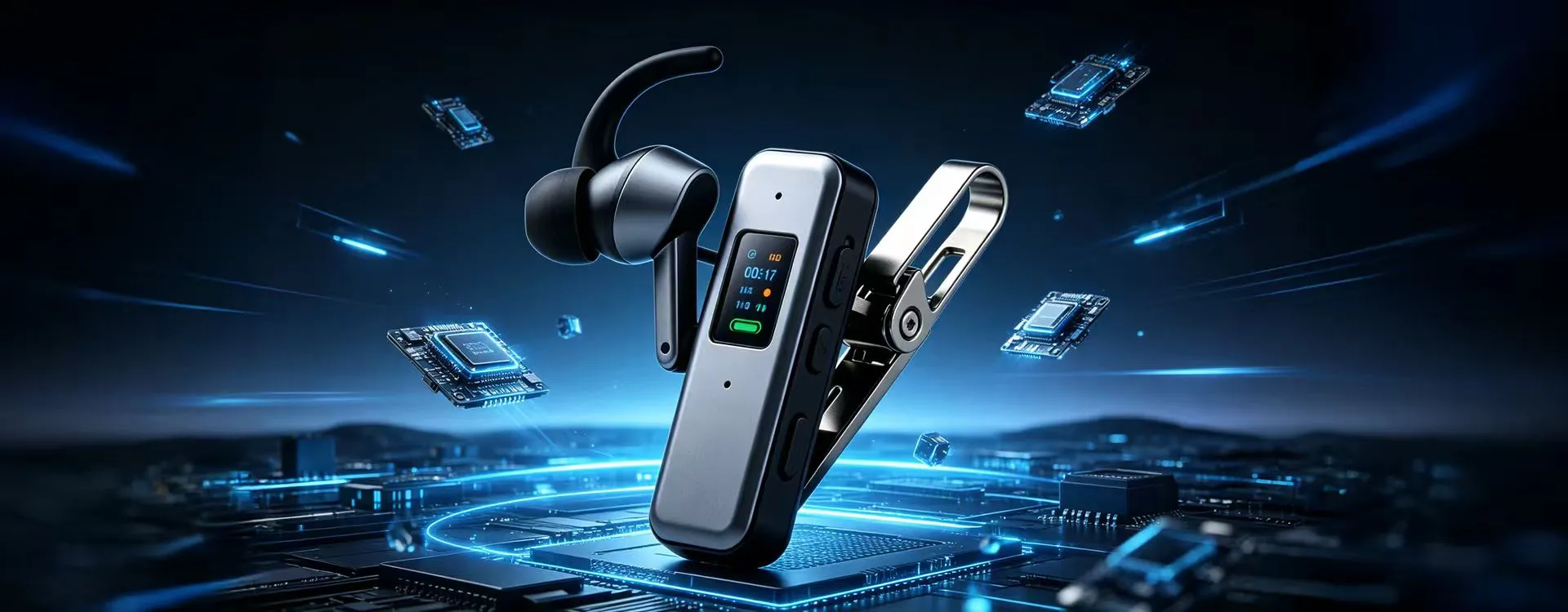
In video meetings, far-end audio played through the local speaker is picked up again by the local microphones, creating acoustic echo. Without processing, the other side hears their own delayed voice, making conversation nearly impossible. Traditional designs put AEC in the cloud or in a breakout box, which adds latency and degrades under network jitter. The Mountain View BP26 series moves echo cancellation into the terminal DSP. Take the BP2640Ax as an example: its three 32-bit ADC channels deliver an SNR of 105dB or better, and with on-chip DSP headroom it estimates the loudspeaker reference signal and adaptively cancels echo in real time at the capture stage. The result is low latency and stable performance even on weak networks.
The two chips target different terminal scales. The BP2640Ax comes in a 5×5mm QFN40 package with three ADC inputs, suited to single- or dual-mic desktop conference microphones and compact speakerphones; its differential DAC output reaches a 120dB SNR for high-quality loudspeaker playback. The BP2668Dx steps up to an 8×8mm QFN68 with four ADCs (SNR ≥105dB) and four DACs (SNR ≥112dB), 39 GPIOs and a 30-channel SAR-ADC, supporting 4-mic ring arrays, rich button/LED I/O, and integrated RTC and CAN interfaces for full-featured conference speakerphones and all-in-one video terminals. Both support Bluetooth 6.0 dual mode and a private 2.4GHz link with sub-5ms latency, so wireless expansion microphones stay in near-perfect sync with the host unit.
Conference noise comes mainly from HVAC, keyboards, and overlapping speakers. Our implementation on the BP26 platform works in three layers: front-end beamforming over the mic array to suppress off-axis noise and reverberation; mid-stage statistical noise estimation with spectral or Wiener filtering for stationary noise; and back-end double-talk detection that dynamically adjusts AEC adaptation step size and NLP strength when both sides speak simultaneously. Double-talk is the hardest part of conference AEC — adapting too fast risks divergence, too slow leaves residual echo. The BP26's DSP headroom accommodates a full adaptive filter plus double-talk state machine, and we tune parameters per room based on measured reverberation time.
Shenzhen Liwei Electronic Technology provides complete BP26 conference solutions: schematic and PCB design including RF antenna routing optimization, acoustic chamber guidance for the enclosure, DSP algorithm tuning, RED/FCC certification support, and volume manufacturing on 8 fully automated production lines. Trusted by 15+ well-known brands and over 300 customers. To evaluate the BP2640Ax or BP2668Dx for your conference product, Request a Quote and our engineers will respond with a tailored proposal.
Q: How does local AEC on BP26 compare with cloud-based echo cancellation?
A: Local AEC has no network round-trip delay, so suppression is stable regardless of packet loss or jitter. Combined with multi-mic beamforming, residual double-talk echo stays below perceptibility in typical meeting rooms, and subjective quality beats cloud-only pipelines.
Q: Why use the private 2.4GHz link for wireless expansion microphones?
A: The private link delivers sub-5ms point-to-point latency — far below standard Bluetooth A2DP/HFP paths — with dedicated-channel operation and retransmission, keeping multiple microphones well synchronized for a host speakerphone plus wireless expansion mic topology.
Q: How do I choose between BP2640Ax and BP2668Dx?
A: Pick the BP2640Ax (QFN40, three ADCs) for compact single/dual-mic microphones or speakerphones; pick the BP2668Dx (QFN68, four ADCs, 39 GPIOs, RTC/CAN) for 4-mic arrays and all-in-one terminals. Liwei provides selection guidance and reference designs.
Shenzhen Liwei Electronic Technology Co., Ltd has over 10 years of experience in audio and conferencing electronics, providing Mountain View BP26 chip selection, complete PCBA design and volume production for 15+ well-known brands and 300+ customers. Request a Quote for a tailored conference audio solution.
Keywords: Mountain View BP26, conference noise reduction, acoustic echo cancellation, double-talk processing, conference speakerphone solution